MDM BLOG

Independence at Home Organizations as implementors of Goldilocks care?

The New York Times offers an OpEd written by Jack Resnick, a NYC solo internist. In this article, Dr, Resnick discusses delivering care at home and highlights the health and economic opportunities afforded by this practice, particularly among the elderly and highly disabled. Of course, these patient groups are often complex and have multiple comorbidities.

The opportunity afforded clinicians who assess patients at home is that of a highly detailed understanding of the context in which caregiving (including self-care) is taking place and on the ways care is being implemented.

A colleague working a few years back in the Peruvian jungle noted that pill blisters were accumulating around a religious icon sitting on a shelf. The patient felt that this was the way in which these medicines would be most conducive to improved her health.

Clinicians accessing patients at home also reduce access barriers to care and can make care delivery fit the context of these patients and their caregivers. By clinicians I mean not only physicians but also nurses, pharmacists, social workers, dietitians, coaches, and other healthcare workers.

As consultants and sales people know, travelling to make sure you have enough face-to-face contact is important to develop relationships and make fruitful connection. Chronic care delivery clinicians know the same thing. As both are finding out, tools to achieve that connection cannot replace the power of the personal visit, but certainly supplement it. To make models of home care affordable will require a combination of in-person and technology enabled contacts, with the former always administered in sufficient dose before shifting to the latter.

Healthcare reform in the US has provisions to support Independence at Home Organizations. Very little research into technologies to support home care delivery and in ways to support and enable the informal care network that is home-based exists. It would be critical when developing rules for these organizations that the burden they may impose on patients and caregivers be kept to a minimum by design, that they connect with communities to improve patient and caregiver capacity, and that they proceed efficiently in a patient-centered fashion.

That this connects with Minimally Disruptive Medicine is hinted by Dr. Resnick himself, the author of the OpEd.  He states:

For too long the institutions that make up our health care system — hospitals, insurers and drug companies — have told us that “more is better”: more medicines, more specialists, more tests. To rein in spending and deliver better care, we must recognize that the primary mission of many an institution is its own survival and growth. We can’t rely on institutions to shrink themselves. We need to give that job to patients and their doctors, and move health care into the home, where it is safer and more effective.

Perhaps too much to ask of a single solution set, but perhaps not. For those who are home bound and for those for whom the current system fails them by overwhelming them, home delivered care may represent one more tool to deliver care that fits.

Independence at Home Organizations as implementors of Goldilocks care?

The New York Times offers an OpEd written by Jack Resnick, a NYC solo internist. In this article, Dr, Resnick discusses delivering care at home and highlights the health and economic opportunities afforded by this practice, particularly among the elderly and highly disabled. Of course, these patient groups are often complex and have multiple comorbidities.

The opportunity afforded clinicians who assess patients at home is that of a highly detailed understanding of the context in which caregiving (including self-care) is taking place and on the ways care is being implemented.

A colleague working a few years back in the Peruvian jungle noted that pill blisters were accumulating around a religious icon sitting on a shelf. The patient felt that this was the way in which these medicines would be most conducive to improved her health.

Clinicians accessing patients at home also reduce access barriers to care and can make care delivery fit the context of these patients and their caregivers. By clinicians I mean not only physicians but also nurses, pharmacists, social workers, dietitians, coaches, and other healthcare workers.

As consultants and sales people know, travelling to make sure you have enough face-to-face contact is important to develop relationships and make fruitful connection. Chronic care delivery clinicians know the same thing. As both are finding out, tools to achieve that connection cannot replace the power of the personal visit, but certainly supplement it. To make models of home care affordable will require a combination of in-person and technology enabled contacts, with the former always administered in sufficient dose before shifting to the latter.

Healthcare reform in the US has provisions to support Independence at Home Organizations. Very little research into technologies to support home care delivery and in ways to support and enable the informal care network that is home-based exists. It would be critical when developing rules for these organizations that the burden they may impose on patients and caregivers be kept to a minimum by design, that they connect with communities to improve patient and caregiver capacity, and that they proceed efficiently in a patient-centered fashion.

That this connects with Minimally Disruptive Medicine is hinted by Dr. Resnick himself, the author of the OpEd.  He states:

For too long the institutions that make up our health care system — hospitals, insurers and drug companies — have told us that “more is better”: more medicines, more specialists, more tests. To rein in spending and deliver better care, we must recognize that the primary mission of many an institution is its own survival and growth. We can’t rely on institutions to shrink themselves. We need to give that job to patients and their doctors, and move health care into the home, where it is safer and more effective.

Perhaps too much to ask of a single solution set, but perhaps not. For those who are home bound and for those for whom the current system fails them by overwhelming them, home delivered care may represent one more tool to deliver care that fits.

Caregivers – overwhelming the silent

To deliver minimally disruptive medicine, it is key to reduce the workload and enhance the capacity of the patient while pursuing patient goals.

Often, the workload is not faced by the patient alone – a caregiver shares the load. Sometimes, the caregiver carries all of it. Caregivers are seldom compensated for their work, they give up a lot, and their health and other needs are poorly addressed.

Some patients with multiple chronic conditions cannot recruit caregivers because they do not look disabled or terribly sick. Without caregivers, these patients cannot face the workload the healthcare system imposes on them.

Thus, caregivers (or their institutional substitutes) are a key component of a system of healthcare delivery for the 5% of patients with multiple conditions that accounts for the majority of healthcare costs.

These series of collated thoughts (a propos of the national caregiver month) regarding caregivers and their role and about some important efforts to support them are important for those who are working to design a healthcare that fits the lives of these patients. Think of the caregivers, honor their role and support them to ensure that their workload does not exceed their capacity.

Communities and their role in improving care for the five-percenters

In our quest toward ‘goldilocks medicine’ we traveled in mid November 2011 to St. Louis Park near Minneapolis, Minnesota. We were invited by city officials and organizations — including Park Nicollet Medical Home Program and Park Nicollet Foundation — convened by Marjorie Herdes and William Stockton from Mobius to discuss new city initiatives.

I shared some new thoughts along with some standard stuff about minimally disruptive medicine.  The new thoughts refer to the role communities can play in reducing the burden of treatment for patients with multiple chronic conditions.

They were particularly impressed by data from Mayo Clinic showing that patients with 3 or more chronic conditions account for 5% of Medicare patients and incur 50% of all healthcare expenditures. These data is similar to that reported several years ago from the MEPS; as opposed to what I would have predicted this 5:50 rule appears to have remained the same for the last 15 years (see this from 1996 and this from 2008). Also, the latest report from the MEPS (2008) identifies 10% of the population now accounting for 60% of all healthcare expenditure. This group is most likely female, poor, of an ethnic or racial minority and with poor self-rated health. Of note, 1% of the population accounts for 25% of healthcare costs!.

Returning to the 5:50 rule – the fact that counting comorbid conditions can identify this group offers an opportunity for targeting folks on the basis of their complexity. The challenges of this 5% include a very large burden of treatment which often exceeds the capacity of patients and of their caregivers and leads to reduced healthcare access and use, and poor self-care, i.e., to bad outcomes.

While the Chronic Care Model and other forms of intensive primary care can enhance the quality of care for patients with chronic conditions, these models have failed to account for the workload-capacity imbalance that often characterizes these patients and leads to waste and poor outcomes through poor treatment fidelity.

What could organized communities do about this?  How could they improve patients’ capacity to face the workload of comorbid chronic disease, improve their health, and bend the cost curve?

Many ideas were considered and discussed, greatly facilitated by the work our colleague Nathan Shippee, a brilliant sociologist, has been advancing to understand the balance of capacity and workload in these ‘five-percenters’.

Nathan Shippee, PhD

Capacity seems to result from marshaling resources in the following domains:

  • Personal: resilience, physical and mental function, quality of life, self-efficacy, literacy, education, values
  • Medical: design of healthcare services, accessibility and outreach, care coordination
  • Financial: transportation, communication, housing, coverage, access
  • Social: emotional, social, and instrumental (practical) support
  • Contextual: neighborhood design, healthy environment and resources, location, safety

Community programs that could provide resources in one or more of these domains could partner with primary care medical homes focused on this population and help enhance their capacity to face the existing (and hopefully shrinking) workload of being a chronic patient.

Turns out that at St. Louis Park there are already many organizations and programs that offer services that could enhance capacity for patients and caregivers. Everyone in the room agreed that the challenge is to make eligible folks aware that these services exist, often at no cost to the beneficiaries.

Of course poor access to help is a hallmark of an overwhelmed patient, one whose workload exceeds their capacity.  Thus a key priority is to work with existing programs to explore how much work does it take to access and use their services and to redesign their offerings to reach out to these folks in a minimally disruptive way.

This innovation – of communities that reach out to patients and caregivers to optimize their treatment burden – may hold an important key in improving population health, enhance the experience of care, and bend the cost curve, probably in that order.  Given that many of the patients are relatively young, the community will benefit not only from lower per capita healthcare costs but also a closer-knit community with its members contributing to its development and well being. And they would help healthcare systems produce better outcomes as they pursue minimally disruptive medicine. Seems like it will take a village.

Dashboards and online networks – some tools to support goldilocks healthcare

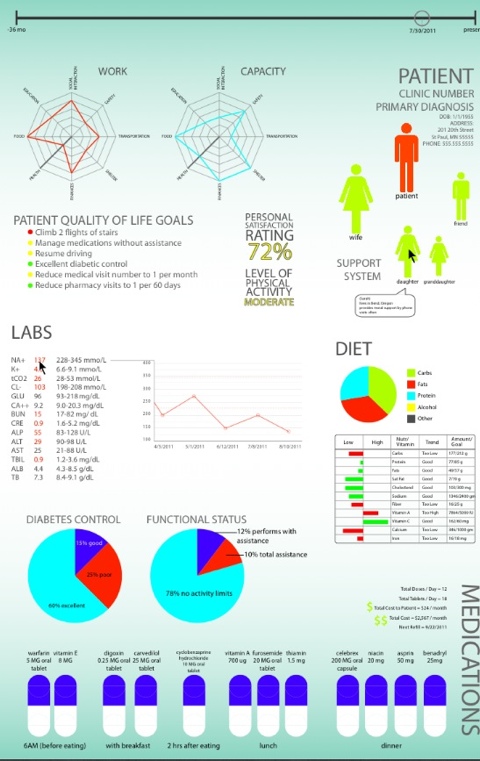
Our team has been playing with some mock designs of interactive tools to support care plans and achieve important reductions in burden of treatment.

20111123-223225.jpg

Also, we are impressed by some online networking tools (e.g. Tyze) that can rally support for the patient-and-caregiver team and perhaps be used to increase their capacity to take on whatever work is left to do, improve their resilience, and enhance their performance. Patient and caregiver are already doing this dynamically (see figure) but they would benefit from their “village”.

20111123-223246.jpg

Care plans and goldilocks healthcare

By Allison Verdoorn
Designer researcher at Mayo Clinic Center for Innovation

Patients with multiple chronic conditions often experience not only the burden of their physical illness but also the burden of treatment caused by the work associated with the interventions prescribed to them by their medical team. While the work a patient has to do increases, the illness that necessitated the treatment typically reduces a patient’s capacity to do that additional work.

The Minimally Disruptive Medicine model seeks to reduce the burden the medical community places on patients in the delivery of care. With interventions that range from reducing the amount of paperwork a patient is asked to filled out to consolidating prescription pickup and refill times to coordinating appointments of families and spouses, the Minimally Disruptive Medicine model identifies the elements within the health care system that add more workload onto patients and works to eliminate those tasks from their experience.

Care plans are widely recognized as a need across many areas, both inpatient, outpatient and out among community health services. Our vision for a care plan is that it is more than just a document, but a shared reality that is created together with the patient. This speaks not only to the need to create a space for shared decision making among patients, their families, clinic care team, and community resources, but also to display this information in a way that is readily accessible to all involved.

The Community Health Transformation platform at the Center for Innovation is connecting with Minimally Disruptive Medicine and Shared Care Plan teams at Mayo Clinic to understand how dashboard tools can help the clinical team, patients, caregivers, and their social support networks to visualize patient goals, levels of health care workload and capacity, and to assist in decision making and interventions.

Farmacia minimamente impertinente

Desde La Sala de Lectura, el muy recomendable blog del Rincón de Sísifo, viene un primer eco a la presentación sobre Medicina Minimamente Impertinente que dimos en el congreso nacional de farmacéuticos de atención primaria en Bilbao.  Fue un gran placer presentar en esta ocasión y disfrutar luego de los comentarios en twitter y en este blog sobre lo que podría ser.  Gracias por soñar con nosotros.

Medicina minimamente impertinente

Here is the video of my presentation in Spanish about MDM at the National Meeting of Primary Care Pharmacists in Bilbao, Spain in October 2011.

Aqui esta el video de mi presentación en español sobre Medicina Minimamente Impertinente en el Congreso Nacional de Farmacéuticos de Atención Primaria en Bilbao, España en octubre 2011.

http://www.irekia.euskadi.net/video/flowplayer-3.2.4.swf

Fuente: Irekia – Gobierno Vasco